Media
Soda & Walnut Media Blasting in Belleville
Soda and crushed walnut shell are gentle blast media for surfaces a hard abrasive would cut, pit or fuzz. Belleville Blasting Co. uses them on fibreglass and gelcoat, aluminium, wood, engine parts, classic car panels and log homes, at the shop or on site in Belleville and the surrounding area.
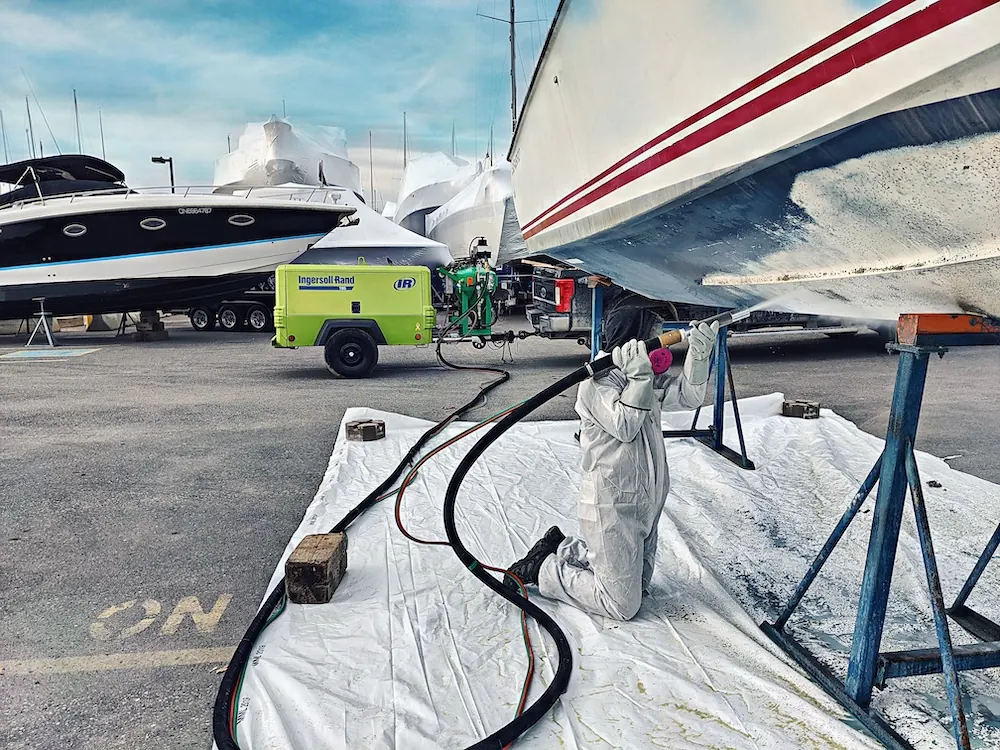
What soda and walnut leave behind
Sodium bicarbonate, sold as soda, and crushed walnut shell sit at the soft end of blast media. They knock paint, grease, carbon and loose coatings off by impact. They are the media we pick when the part under the coating is what you are trying to keep: gelcoat, a thin aluminium panel, a wooden boat or a log wall.
Recycled glass cuts faster and leaves the anchor pattern we want on structural steel, trailer frames and docks. On a classic roof skin or a fibreglass deck, that glass is the wrong tool. Soda and walnut take the failed layer off and stop. A hard grit frosts aluminium and can chew a soft gelcoat.
Soda, walnut and dustless blasting
Soda is the softest of the three. The crystals shatter when they hit, so they are less likely to embed in soft metal. It suits light paint, grease, oil film and oxidation on parts that cannot take a cut: aluminium engine covers, greasy castings and thin painted trim. If soda is not lifting the coating, we step up rather than leaning harder on the trigger.
Walnut shell is still gentle next to glass, and it has more bite than soda. The grit is angular enough to lift paint and carbon. We use it on classic car panels, wooden trim, log homes and fibreglass when the gelcoat should stay. It holds up in the pot longer than soda, which matters on a larger panel or a log wall with finish packed into the checks.
Dustless blasting is not a softer media. Water meets the abrasive at the nozzle and knocks the dust cloud down. The grit can still be hard, which is what we want on boat bottoms, frames, docks and masonry. Conventional dry blasting with recycled glass is the other end of the scale: heavy rust, thick coatings and structural steel.
When to use each
Choose soda when the coating is light, the part is oily, or you want the least cutting action. Choose walnut when soda is too mild and glass is too sharp. A classic panel with thin paint, a wooden boat, a log home with tired stain in the checks, and a fibreglass part with sound gelcoat are walnut jobs. The aim is a clean surface, not a profile you could coat a bridge with. Walnut also reaches into seams and bolt circles on engine parts where carbon and old gasket material sit.
Choose dustless or conventional blasting when the goal is bare steel, heavy rust, thick antifoul or a coating that needs a real anchor. A rusty frame, a trailer, a steel dock and a hull being opened for a new barrier coat belong there. One vehicle can need both: walnut or soda on the panels, and a dustless or dry blast on the frame. We say which is which from photos before any work starts.
Where the work happens
Small parts, engine pieces and loose panels come to the 7,000 sq ft heated shop at 25 Dundas St W in Belleville. Log homes, wooden boats and larger fibreglass jobs can stay where they are. The mobile unit covers Belleville and the surrounding area. On an old or unknown surface we test a small area first. If the gelcoat is already thin, or the aluminium was blasted once before, that test tells us whether to stay with this media or to stop. Hours are Monday to Friday, 8am to 4pm.
Blasting is the prep. If the part needs a primer or one of the liquid coatings we already apply, we can do that next. A gentle blast does not leave the deep profile a heavy coating wants on structural steel, so the coating has to match the surface. Send photos through the instant estimate or the contact form. Call (343) 600-0391.